


Hello Everybody! If you are reading this, this is my very first blog post on my website, The Theoretical Doctor. Welcome!
The tiring almost 2 weeks of exam has finally come to an end for which I am grateful for. But the question is “What’s next?”. However, I shall save that for a separate post, so do check that out!
A short background of where I studied before I begin. As of now, I have just completed my final year in “Bachelor of Medicine, Bachelor of Surgery (MBBS)” in MAHSA University, Malaysia and I am of Batch 9 (2017-2022). It comprises of a total of 5 years and yes, I’ve just completed my fifth and final year.
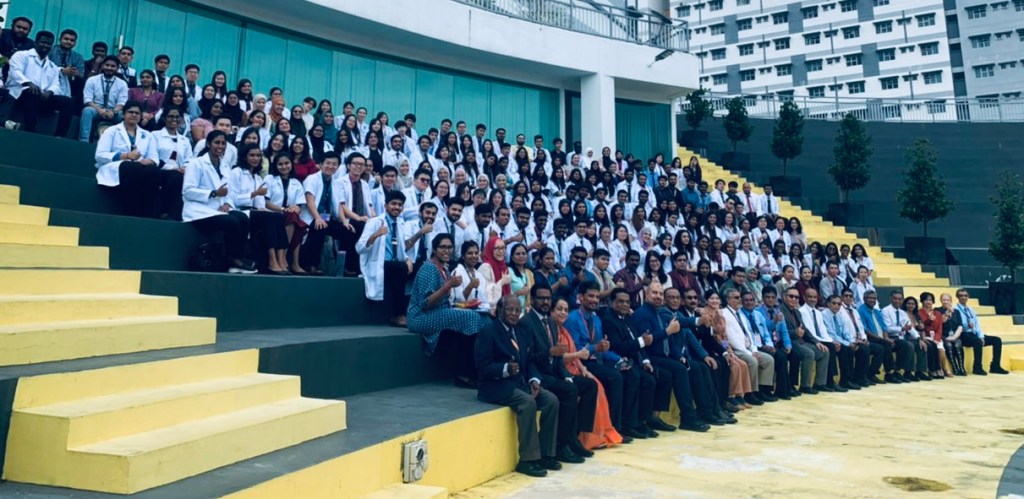
My first two years (Pre-Clinicals) were conducted in the main campus of Bandar Saujana Putra, Jenjarom, Selangor. The following three years (Clinicals) were then conducted in Hospital Sungai Buloh and PKKN (Year 3), Hospital Kuala Lumpur (Year 4 & 5), Menara Teo Chew as well as my trusted devices during the pandemic and lockdown.
Anyway, back to my experience during the exam.
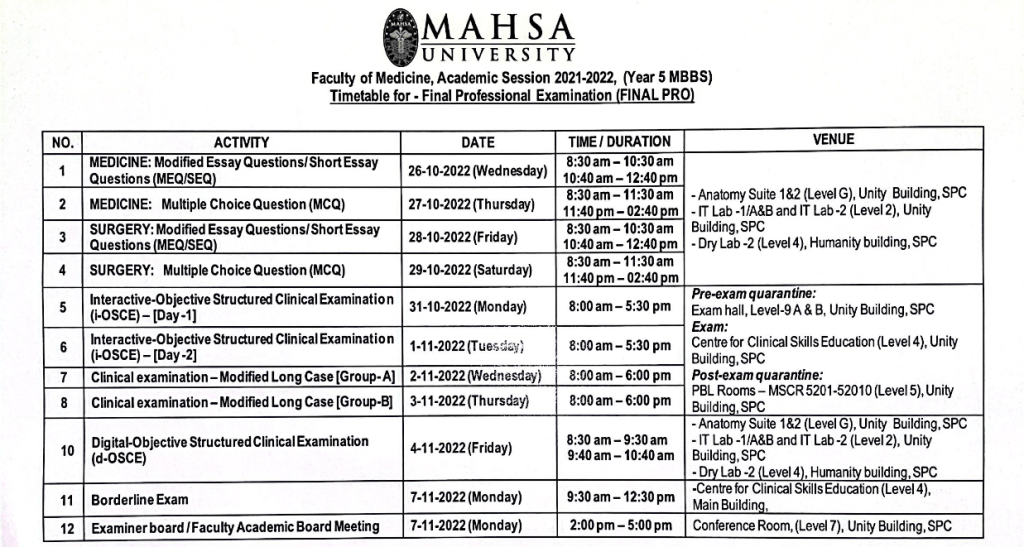
The exam was conducted for a total of 10 days, from 26th of October 2022 till 4th of November 2022 at MAHSA University, Bandar Saujana Putra, Malaysia. Yes, the main campus and starts as early as 8 a.m, well, some of them, not all.
I live in Kuala Lumpur and ever since the restrictions were loosened and lifted in Malaysia, things have returned to near normal or in other words, chaotic, especially when you live in the city. The campus however, is about 30-40 minutes away from my place of residence. I also happened to live with a housemate who is a dear friend of mine. Thankfully, I had her around during that time as she kept me accountable in studying, getting up early and leaving early (mainly to avoid the traffic).
Aside from that, I had the option of staying on campus in the hostel, which many of my batch mates did. However, considering I needed my devices a lot as my books were all in there, not to mention, my clothes, the comfort of my room, foods and snacks, I was rather hesitant in considering acquiring an accommodation on campus. Granted, it would have saved me a lot of money. But in the end, nope. I decided against staying there. Hence, I travelled back and forth everyday via Grab and sometimes inDriver.
As I’ve mentioned before, the traffic in Kuala Lumpur and some parts of Selangor can become really congested during the peak hours typically in the morning and evenings. A typical 30-40 minutes of journey can stretch up to an hour and a half or sometimes even 2 hours.
Since the examination begins at 8a.m. and on some days it would be around 9 something, me and my friend made it a point to leave at the latest, 2 hours before the exam begins. Thus, you would be able to guess, we would be leaving during the wee hours of 6a.m. at the latest but we usually leave a few minutes earlier than that as the prices in Grab or inDriver tend to increase during peak hours.
This led me to waking up around 4a.m. to 4:30a.m. almost everyday during the exam week. Honestly, it was not easy for me and many times, I have been tempted to press the snooze button. Thankfully, I did not of course. Leaving during the wee hours, I tend to fall asleep during the journey although at times, I tried to read my notes on my phone but as the day during the week progresses, sleep has won and taken over.
We usually reach campus by 7, a little before that on most days unless it happened to be raining. Our usual hangout spot would be the cafeteria, also known as “The Habitat” and basically just catching up on our reading while having breakfast. It became a routine for me to get breakfast first and thankfully by that time, the Chinese Stall would be opened. The others usually open much later during the day.
Besides that, we had to be at our designated locations at least 30 minutes prior to our exam but I only did that on the first day and on most days, I would be there 10 minutes earlier because we would have to wait outside anyway.
THEORY EXAM
For the theory part of the examination, it was conducted on the University’s e-learning portal, also known as “LMS”. It is not something new for us as during the pandemic and even when it was lifted, our end-posting examinations were usually conducted on the e-learning portal. But what was new was conducting the Final Professional Exam online.
We weren’t allowed to use our devices of course for fear of cheating and communication during the exam. Instead, we used the computers provided in the university. Hence, we just had to log into our accounts and answer it there. Thankfully, the speed of the internet as well as the computers were good. Thus, we did not encounter any network issues or lags during the exam.
We were divided into 2 groups which were Group A and Group B, so there were two sessions per day. It started with Group A first on the first day of the exam followed by Group B and the following day, it would alternate. For the first group that went in, there is a post-exam quarantine period of around 10-20 minutes in a separate room while the next group enters and begin their exam and only then, the first group is allowed to leave. This was done to prevent communication between the members of both groups.
After we were done for the day, we can return home, only to have it repeated again, the following day.
STRUGGLES FOR THE THEORY EXAM
There were multiple struggles that I faced for my theory examinations. One of which was the fact that I had to sit idly for long periods of time while maintaining my concentration as I am naturally a person who always gets up in between to walk around or to grab a snack.
For Modified Essay Questions (MEQs) and Short Essay Questions (SEQs), it did not feel like 2 hours as we were required to type. Hence, all sleepiness would usually be aborted by then and my concentration would be near maximal. My weaknesses were definitely tested during the Multiple Choice Questions (MCQs) portion which comprised of a total of 180 questions, 90 questions for Medicine and Surgery portion each. Both were conducted on separate days but for a duration of 2 hours and 15 minutes each session.
My group seemed to have acquired the shorter end of the stick as we fall into the second session for both times which means, our examination would begin around 10 something in the morning and lasts till around 12 something in the afternoon. Sitting idly and choosing one answer, although seemingly enough an easy task, was one of the most difficult thing for me as my concentration would be almost to its minimal. I found myself rereading a stem of question multiple times as it was not registering in my head.
A session which typically lasts me 40 minutes to an hour led me to fully utilise the 2 hours and 15 minutes allocated for us as I was extremely drowsy during the session.
In terms of difficulty, the MEQs and SEQs were of moderate difficulty. However, I wish that I could say the same for MCQs but nope. Maybe it was and that I definitely lack practice which I’m sure I did but in combination with my drowsiness during the exam, things definitely did not become easier.
CLINICAL EXAM
The clinical portion of the examination began on a Monday, 31st of October 2022. The first 2 days were on Interactive-Objective Structured Clinical Examinations (I-OSCEs) which consists of 5 stations each day and for 5 minutes each station followed by Modified Long Case (MLQ) on Wednesday and Thursday and finally, Digital-Objective Structured Clinical Examination (D-OSCE) on Friday.
I-OSCE
We had to report ourselves for pre-examination quarantine a little before 8a.m. at Level 9, Examination Hall whereby we were told to keep our devices away and only certain number of written notes and dried foods were allowed.
We did not go according to our namelist. Instead, they divided us into a few subgroups and a representative of each subgroup had to drew lots. Unfortunately, my subgroup were the last to enter and the wait was excruciating. We were quarantined till almost 12p.m. at the Examination Hall before we were directed into another room in Level 4. After which, we were directed again to another quarantine room on the same level.
The rest of the subgroups were allowed to leave after they have completed the examination and mine ended around almost 3p.m.
The following day, my subgroup were number 8 to enter and we were done an hour earlier than the previous day.
The IOSCE examination tested our skills on focused examination, focused history taking, knowledge on the device usage as well as counselling in several postings such as Medicine, Paediatrics, Psychiatry, Primary Care Medicine, Surgery, Obstetrics and Gynaecology, Emergency Medicine and Orthopaedics.
Overall, the wait for our turn during the exam was actually more excruciating than the actual exam itself and thankfully, things went relatively well.
MLQ
The preparation for this examination was the toughest one by far. We were told that we would be assessed on 2 of the 3 postings which were Internal Medicine, Surgery and Obstetrics and Gynaecology. However, the topics to be covered in just 1 of these postings itself was astronomical and though we somewhat had the gist if a particular topic were to be thrown at us, mastering each and every one of that topic is quite the challenge when memorisation is not your strength which unfortunately, is my weakness.
As I’ve mentioned before, although we had initially covered whatever is required, we only remembered the gist of it. Basically, “A Jack of all trades”. I was part of Group A, hence my MLQ was on a Wednesday.
Despite the exhaustion from the previous 2 days of clinical examination, I remembered pulling an all nighter which I strongly discourage but we have got to do what is necessary, right?
I was of course, tempted to just throw in the towel, call it quits and retire for the day but I took comfort in the fact that I would be having a day off the following day before D-OSCE as I was not part of Group B.
As usual, woke up around 4-5a.m. and got ready. Read some short notes and finally, out the door! This time, no lots were drawn at 8a.m. Instead, we would either move in ascending or descending order, according to our namelist. We moved in ascending order and as usual, Level 9 Examination Hall followed by Level 4 Pre-Quarantine Room 1 and finally, Room 2.
Remember when I mentioned that we would only be tested on 2 out of the 3 postings? We had to draw lots for that right before entering Pre-Examination Quarantine Room 2. I remembered only “C1” was written on the paper and we still did not know which of the 3 postings we were getting.
Much to my relief, I got Surgery and Obstetrics and Gynaecology postings. I would have very much preferred Internal Medicine but word of ear has it that the case given was not an easy one. Divine Intervention was definitely favouring me that day as my examiners were extremely kind and graceful enough to hint me back on track as I was slipping away.
The challenge there was during the abdominal examination in my Surgery case. It was on a simulated patient who supposedly had a per rectal bleeding for 10 days duration associated with weight loss of 10kg in 2 weeks, no mass, tenderness at right lumbar region and afebrile. Considering, we were used to examining “real patients” in the hospital, creating my patient to explain the positive findings was easier said than done.
Imagine this, I had to begin with “Patient is conscious, afebrile, cachectic and uncomfortable”, when my simulated patient was an extremely healthy looking gentleman, slightly on the heavier side and looking at his abdomen, definitely did not make things easier. Finally, I gave up and explained the “real normal” findings.
For both the long cases, a dummy was provided and for Surgery, I had to perform a per rectal examination as well as proctoscopy. Whereas for Obstetrics and Gynaecology, I had to perform a bimanual examination as well as a per speculum examination.
Personally, I felt at ease and as I mentioned before, the examiners were extremely kind and gracious enough. Of course just as in IOSCE, the wait was more excruciating than the actual examination.
D-OSCE
The worst part is over and finally, D-OSCEs. We had to follow according to our two subgroups which were Group A and Group B. Group B began first on that day followed by Group A.
D-OSCEs consisted of a total of 13 questions to be answered in 1 hour and it consisted of pictures followed by a set of questions. It was a written exam, answered of course on the University’s e-learning portal “LMS”.
Honestly, this particular examination felt the easiest among all the other examinations. Thankfully, everything went smoothly and after we’ve completed, there was a photo taking session and you can only imagine the joy and relief plastered across the students faces.
REFLECTION
To sum things up, these previous 2 weeks felt the longest although time was moving relatively fast. The emotions experienced during this period were filled with highs and lows with occasional outbursts.
My learning outcome from this experience was definitely my test of patience as multiple times, I was on the brink of bursting at my friends. However, reverting to understanding their situation and not putting myself first oddly enough strengthens my patience.
Next, understanding and forgiveness. It is without a doubt, leaks happen and every system has its flaws. There is no perfection anywhere but knowing the people involved and how it went about definitely angered a number of us. Nonetheless, that is just how life is and this is probably just a small matter to even fret about.
Third and last, is my willpower of concentration. Without a doubt, I am definitely a person who has to remain active and not passive. My concentration can only last for so long before I start to fall asleep or my mind starts to wander off and decides to play a particular song on repeat and is louder than my thoughts!
Just like that, the 5 years spent in medical school, educating and training us for these 2 weeks and hopefully to be a better individual, a good doctor, an asset and contributor to society has come to an end. This chapter of my life has closed but the good memories will forever be etched in my memory.
Till then, signing off~


 The Theoretical Doctor