


5 years of medical school. The study, the preparation, the struggles, the breakdowns in between, the missed social engagements, all for these final 2 weeks, the determinant of the title “Dr.” in front of our names.
I have just recently sat for my finals in medical school, otherwise known as, Final Professional Examination (Final Pro) of Batch 9 (2017-2022) of MAHSA University, Malaysia.
The examination commenced for a total of 10 days with 1 day of break in between.
Our theory examination commenced from 26th of October 2022 till 29th of October 2022, followed by 1 day of break on the 30th of October 2022 which was a Sunday while the clinical portion of our examination resumed from 31st of October till 7th of November 2022.
A) THEORY
The theory portion of our examination comprised of:

We were divided into 2 main groups of Group A and Group B and for each group, we were further divided into 3 subgroups. The theory portion of our examination was conducted in three different locations which were the:
- Anatomy Suite, Level G, Unity Building
- IT Lab 1A & B, Level 2, Unity Building
- IT Lab 3, Level 3, Empathy Building
We had to arrive 30 minutes prior to the time allocated for our respective groups.
MODIFIED ESSAY QUESTIONS (MEQs) & SHORT ESSAY QUESTIONS (SEQs)
Both the MCQs & SEQs were conducted in the same day for an hour each. First, the MEQs followed closely by SEQs. Both of which were conducted on the University’s e-learning portal.
The MEQs comprised of a total of 3 postings which were:

There were 1 question allocated for each of the postings listed followed by a series of subset of questions. Basically, it is a long story starting from when the patient is first brought in and a short history and positive findings of the physical examination would be given or maybe even just the chief complaint with a short history and they would ask you on what else you would like to ask the patient or what signs the patient might be presenting with or they could even ask you to come up with a few differentials.
In MEQ, once you have answered that particular page, you are not allowed to go back to change your answer and in the University’s e-learning portal, it has been set in such way.
This is because the story unfolds in the following page whereby the answers to the questions have already been stated. Hence, you pretty much know if you have answered correctly or if you should start praying for a miracle.
1 Posting = 1 Question
1 question can take up to 3-4 pages before moving on to the following posting.
The SEQ component comprised of a given scenario. It is basically a shorter version of MEQ where y it shortens to just a page but with similar questions asked in MEQ.
Questions might be on:
- Provisional diagnosis
- Differential diagnosis
- Investigations to perform
- Diagnostic investigation
- Management
- Pathophysiology
Both Medicine and Surgery component of SEQs consists of a total of 4 postings. 1 question for each posting.
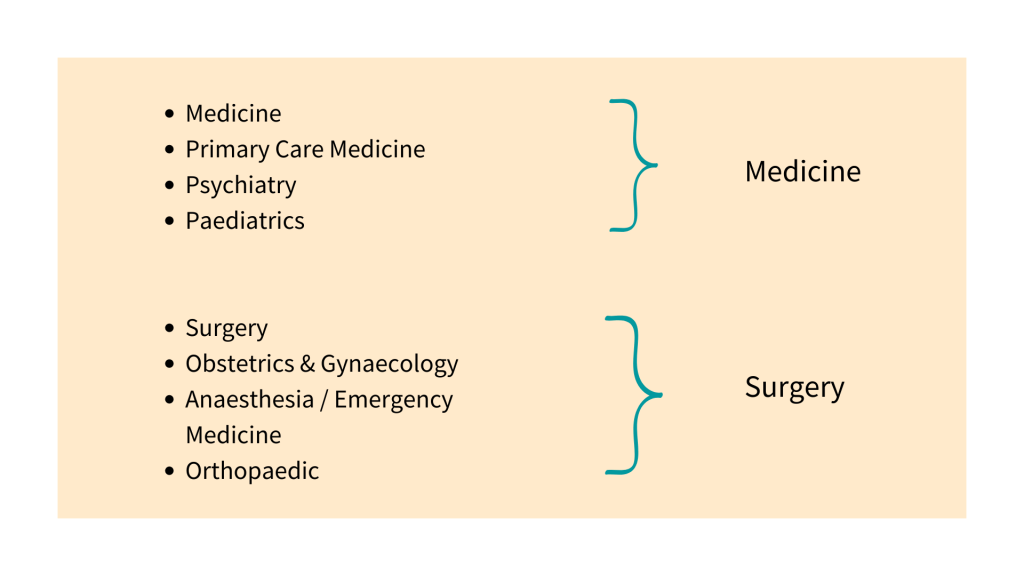
MULTIPLE CHOICE QUESTIONS (MCQs)
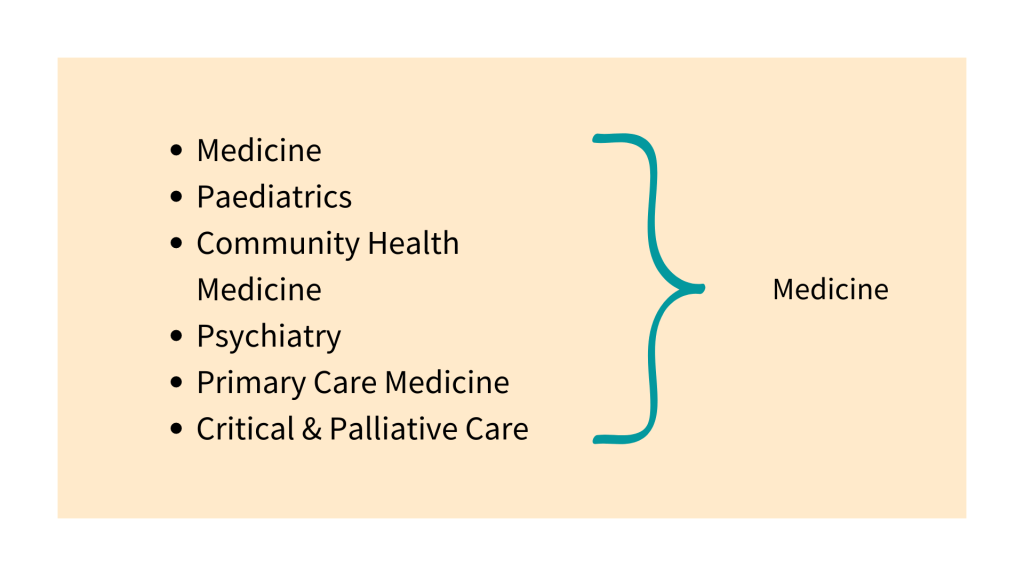
The MCQs consisted of 90 questions each for Medicine and Surgery with each lasting for 2 hours and 15 minutes. It was conducted through the University’s e-learning portal as well.
The tested postings in each component were:

B) CLINICALS
The clinical portion of our examination comprised of:
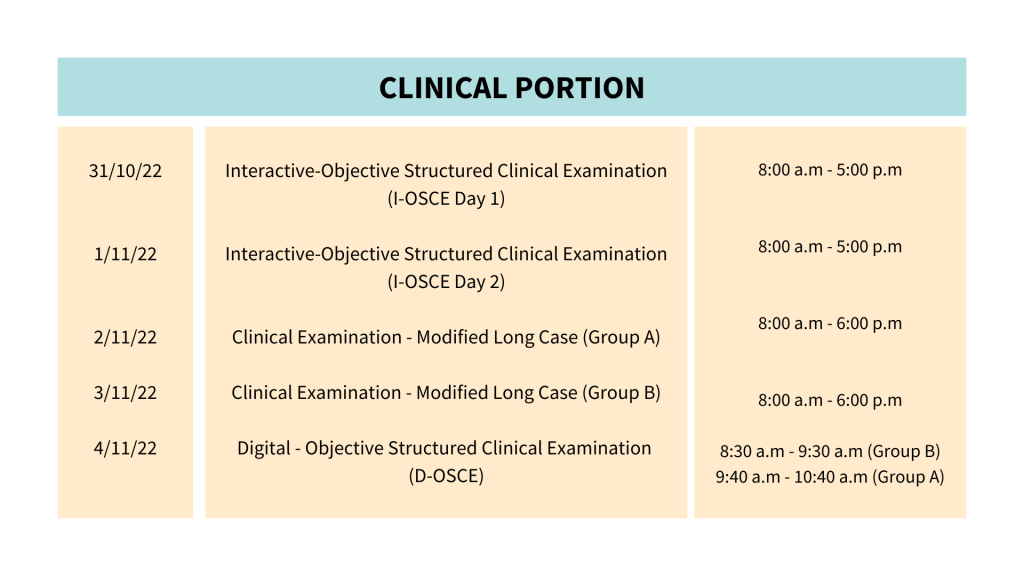
For all the examination in our clinical portion (except D-OSCE), we were required to report ourselves to Level 9, Examination Hall for Pre-Examination Quarantine by 7:45a.m.
We were given a short briefing the previous night before the exam that we were only allowed to bring in our student ID card, examination docket, medical instruments, lab coat, water bottle, dry foods, 15-20 pages of reading materials, one pen/pencil and one empty paper.
Our personal belongings along with our devices were kept in a plastic bag and sealed shut.
INTERACTIVE-OBJECTIVE STRUCTURED CLINICAL EXAMINATION (I-OSCEs)
The I-OSCE examination was conducted for a duration of 2 days, with 5 stations each day.
We were tested on the following postings:

Each station lasted for 5 minutes. We were divided into several subgroups and lots were drawn on the morning of the examination. We then followed accordingly to our numbers based on the lots drawn.
We were initially quarantined on Level 9, Examination Hall before moving to Room 1 and finally Room 2. Both of which were on the same floor, Level 4, Clinical Skills Lab.
In addition to that, we were required to surrender our notes and dry foods before shifting from Level 9 to Level 4.
Since there were 5 stations, each session lasted for around 25-30 minutes. After which, we were allowed to return home.
MODIFIED LONG CASE (MLQ)
For MLQ, we had to follow according to the group division that we were divided into during the theory portion of the examination which were Group A and Group B.
Both groups had their examinations on separate days with different sets of questions but with the same division.
We were told that we would be assessed in Medicine, Surgery and Obstetrics and Gynaecology. But out of the 3 stated, we would only be tested on 2 of it.
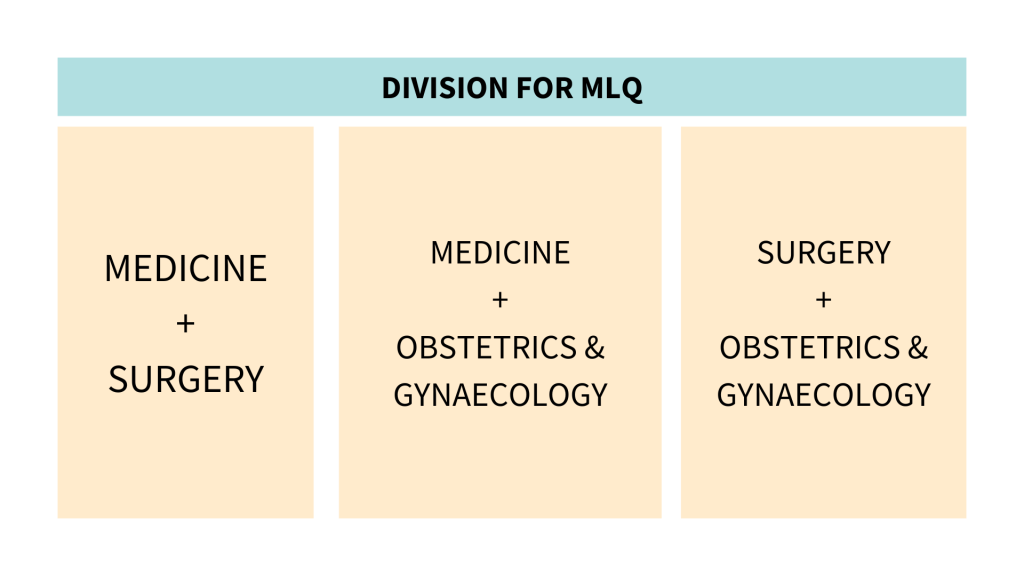
However; we did not know which postings we would be tested on. We had to report by 7:45a.m. at Level 9, Examination Hall. This time, we moved in ascending order of our batch’s namelist before entering into Room 1 and finally Room 2 on level 4, Clinical Skills Lab.
We had to draw lots right before entering Room 2 but even then, the allocated postings that we would be tested on were not known.
Since it is a modified long, with it being a long case nonetheless, only the chief complaint was given on the question paper followed by a simulated patient and dummies if necessary.
We were required to take a focused history, perform a focused physical examination, explain the investigations that we would like to perform as well as the management we would like to do for said patient. This was accompanied by 5 minutes of discussion with the examiners.
Each posting station lasted for 25-30 minutes. Thus, making each session 50 minutes to an hour.
After we have completed the session, we were allowed to return home.
In the I-OSCE as well as the MLQ, we were not only assessed by our own set of university lecturers from the faculty. Instead, we also had several external examiners mainly from public universities as well as some private institutions. Thus, each station typically has 2 lecturers, 1 being internal and 1 external.
DIGITAL OSCE (D-OSCE)
The D-OSCE examination, although part of the clinical component, was conducted on the University’s e-learning portal. It comprised of 13 questions including pictures, mainly to test on our knowledge of data and laboratory interpretation, apparatus and materials as well as certain special tests.
We were divided into two subgroups again which were Group A and Group B with each session lasting for an hour.
That concludes the overview of the Final Professional Examination (Final Pro) of MBBS, Batch 9 (2017-2022) of MAHSA University.
Do read on “I’ve Completed My Finals in MBBS!” for more in depth explanation of the events that took place during the examination as well as my thoughts and feelings about it.

 The Theoretical Doctor