


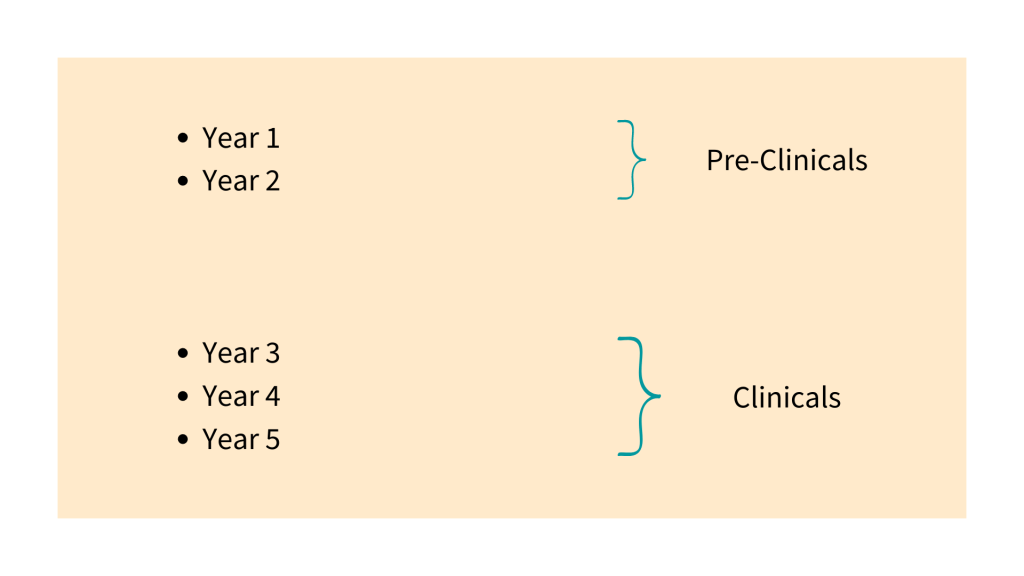
Clinicals during medical school comprises of the remaining three years of medical school (at least where I’m from). My medical school journey consisted of 5 years whereby the first 2 were Preclinicals and the remaining 3 were Clinicals.
Related Posts:
- 6 Strategies For Studying 2 Weeks Before Finals
- 6 Ways To Study In Final Year Of Medical School
- 5 Benefits Of A Study Group In University – Medical School Edition
I remembered being like a lost sheep during the beginning phase of Year 3. Granted, we started going to hospitals, clerking the patients and even had the privilege of watching some surgical procedures or even assisting in them (most of us were not so lucky), I thought that I was set to go for as long as I can survive with the long hours, answer questions during rounds and perform physical examination, that is enough, right?
Well, that was until I was in my second posting in Year 3 and I passed my Clinical Assessment but received a “0” for my theoretical assessment.
It seems that I needed to “read more”.
Read more? Haven’t I done enough by slaving long hours in the hospital? Those sleepless nights and sacrificed weekends, surely I have given more than what I thought was needed, right?
Well, it is a good thing I learnt early on or I probably would not have graduated medical school.
Here are some ways I studied during my clinical years in medical school.
1. Attend ALL Bedside Teachings / Rounds – Go for extra if you are able to.
This is crucial. If it is in your timetable or it is time for your subgroup to attend, do not miss it.
The hospital is the best learning ground, especially if you are a person who learns best from experience (at least for me), and the patients are your best teachers.
I learnt better and retained information efficiently after seeing various cases even if it were new to me.
Granted, I feel inadequate most of the time as I would not know the answer while being asked. however, I learned that with humility, comes learning.
Besides that, if you are able to attend more beside teaching or rounds, do so. There will usually be empty spots in other subgroups and people will be looking for others to fill their position, volunteer if you have the time.
Never turn down the opportunity to learn more.
2. Finish Your “Case Writeup” Within The First 2 Weeks Of Your New Posting
Case write-up. I’m not sure what do you call it where you are studying at. However, it is a form of academic writing of a particular chosen case, clerked by you and the physical examinations performed by you alongside the data from the labs down to the provisional diagnosis, differentials and follow-ups till discharge.
I’m not sure if you have that but I think most university does.
Anyway, for every posting, we were required to submit a case write-up (sometimes two) by the end of the posting.
Completing it early within the first 2 weeks of your posting puts you at ease by the end of the posting as you are able to focus fully on your end-posting examinations or upcoming examinations while others are stressing on all of it. (This happens most of the time.)
It just alleviates some pressure and it is always good to be prepared. Besides that, if the case you have chosen is not suitable, there is always room for a new one if you start early.
3. Clear Your Theory Component In The FIRST 2 WEEKS
During the beginning of the posting, you will be given a timetable which (at least for me during medical school), consisted of a mixture of clinical classes which were bedside teachings as well as theoretical classes (lectures by lecturers, case-based discussions by students or presentations).
The topics will usually be listed by then, although the allocations for presentation has not been done.
I used to list out the topics from there and complete my own reading on these topics within the first 2 weeks of a new posting.
Take the time to see the amount of time you need as this vary for each person. It would be better if you have a “study buddy” to help you with your journey and keep you accountable.
Anyway, by completing the reading of the listed topics from the timetable early, I noticed that I was able to understand better during bedside teachings and also during presentations or lectures in class.
Besides that, it alleviates any last minute studying stress towards the end of posting.
4. Refer To Proper Sources
This differs according to the country of which you are attending medical school.
Take note of the units used as some follow United Kingdom / European units while some follow others.
From there, you are able to discern which international books to refer to and finally determine which books are suitable for you to follow.
If you are good at understanding all units, then it would not cause confusion. However, during medical school, we followed closely to the UK system and guidelines.
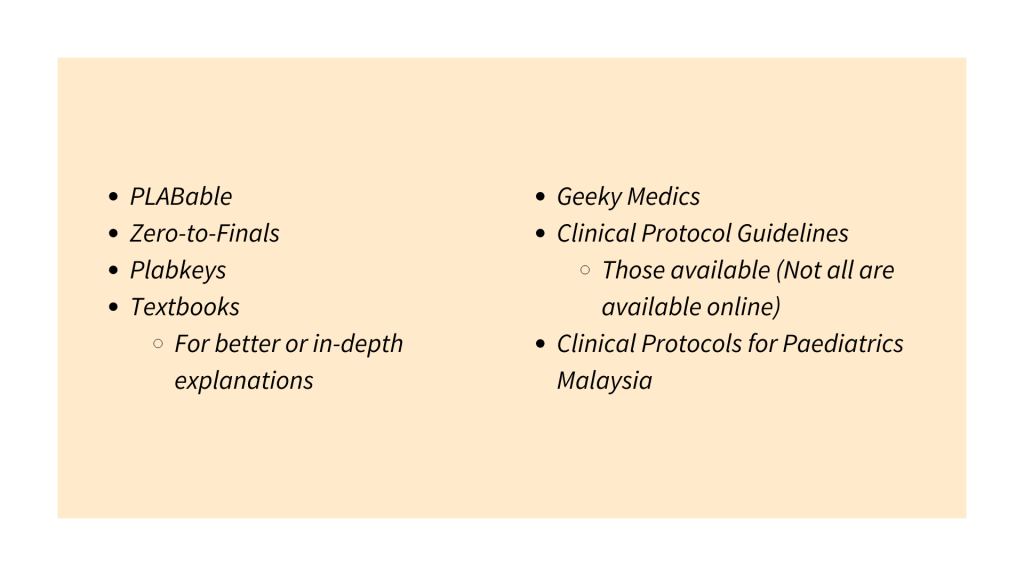
The best guide would be the clinical protocols of the country you are attending medical school as you are able to understand why certain procedures are preferred and why certain patients are managed accordingly as some step-wise managements might differ in certain countries.
Here is an example of what I used to refer to:
5. Do Clinical Case Questions EVERYDAY / NIGHT
This is vital in assessing your theoretical knowledge and keeping you on your toes.
I used to download multiple question books and did them according to my posting, covering the topics listed in my timetable first before divulging in others.
Dedicating a minimum of 3 or 5 questions (this differs according to person) or even a solid hour per day is important in assessing your knowledge or that particular topic especially once you have completed all the topics required for your posting.
Besides that, you will be able to identify the parts you have missed out on.
If you have just dipped your toes into clinical year or is going through it, know that, that is the best part of medical school, although it will be a challenging one.
Try to make the best out of it and if you feel that you are drowning, you are not alone. Many of us have felt that way and you are not alone. Many of us have felt that way and you are able to excel as well!
Thus, I hope you have these few tips useful and will be able to inculcate a little bit in your journey in medical school.

Related posts:
- 6 Strategies For Studying 2 Weeks Before Finals
- 6 Ways To Study In Final Year Of Medical School
- 5 Benefits Of A Study Group In University – Medical School Edition

 The Theoretical Doctor